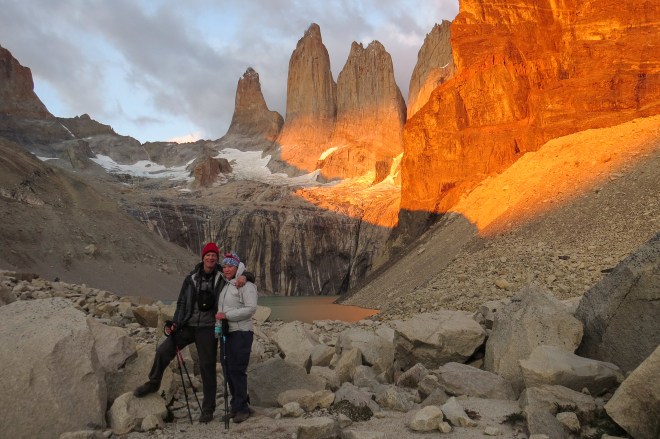
Rob & Toni greet sunrise at Torres del Paine’s towers, Chile
Two months after my hip surgery I hiked up Cardigan Mountain, one of the smaller peaks in New Hampshire. I got tired, but felt no pain in the hip.
Two more months into my recovery, I tackled Mt. Moosilauke, which at 4,802 ft. is fairly tall for the Appalachians. I had some pain coming down, but was able to finish in time to make my dinner date.
But the ultimate test was in Torres del Paine National Park, Chile, about nine months after getting my new hip.
The hike had long been at the top of my bucket list: Torres del Paine was where granite peaks spring skyward from the southern tip of South America. Jagged crags and vertical towers make it distinctive, and incredibly scenic. To me, it seemed like the Grand Tetons on steroids.
Toni had given me a trip there as a birthday present a few years ago, but questions about my hip pain kept us from booking it. Now my new hip seemed strong and comfortable—but would it be up to that much hiking?
An online adventure-travel fixer booked us into the four-day “W-trek”, so-called because it inscribes a W around the southern contours of the mountains with an ascent north into the heart of them in the midst of the tour. We’d stay in communal shelters called refugios, which would provide beds and food, so we wouldn’t have to carry tents, sleeping bags or food. They were about ten miles apart and were booked months in advance, so we’d have to average more than ten miles per day, with no days off or freedom to change our itinerary. I’d done that kind of hiking on the Appalachian Trail with more weight in my pack, and I’d done day hikes since the surgery. But I didn’t know if the new hip would rebel against multi-day trekking.
We scheduled the trip for February, the austral summer. By then, I figured, most of the disturbed tissues should be fully healed, even in an old fogey like me. Fortunately, the trail stayed below 3,000 feet in elevation. Climbing and descending would be moderate. And I lightened my load by aggressively weeding out stuff I might not need.
Toni was another concern. She had overcommitted herself into volunteer activities at home, as usual, and couldn’t find time to practice carrying her full pack even one day (which was all I had found time for). Yet she and I walked dogs a couple of miles per day, and did a spinning class twice a week for about six weeks. I read a book about this hike by a woman who got ready by hiking with a pack for months. Toni shrugged off that thought. “I’m strong,” she said. “I can do it.”
In the end, we couldn’t be sure how we’d do. We’d have to just do it and find out.
The trek started awkwardly. We were supposed to take a boat up Grey Lake to the foot of a massive glacier, where we were due to go kayaking and settle into our first refugio. But gale-force winds and rain cancelled the first sailing. By the time we got up the lake on the early afternoon boat, we had missed the kayaking.
From there, the weather gods smiled on us. We had four days of great hiking in everything from calm sunshine to clouds and the region’s trademark 50 mile-per-hour winds, but never more than a sprinkling of rain. We passed turquoise lakes, rainbows, ghost forests (bleached trunks left by a wildfire) and night stars the size of snowballs. Refugios were cramped but surprisingly comfortable and reverberated with multiple languages.
I did take some naproxen, the anti-inflammatory drug, to ward off any pains, but I probably didn’t need to. The 12-plus miles we hiked the first day was a bit of a slog. But the days got easier. Toni had a painful toe and I developed a heel blister. But I was delighted—my hip never gave me a single twinge.
The highlight came the last morning. We rose at 4:15 and ascended two hours by headlamps up through forest and steep boulders. We reached the park’s namesake towers in the faint glow of dawn, praying that no clouds would block the sunrise. Dozens of hikers huddled in the rocks, waiting. Between 6:30 and 7:00: the rising sun bathed the towers in pink, then red.
Thank you, Dr. Moschetti.

 GetHip!