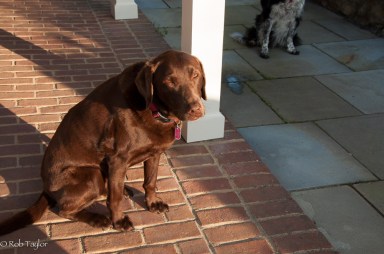
Dogs played leading roles in my hip story. They exposed the ailment—and reaped the benefits of my getting it fixed. I first felt hip pain running on a Virginia forest trail with Gretchen, our chocolate lab, and Maid, our border collie. Chugging down one steep incline, I felt a stab of pain in my right hip. What’s that? I asked myself. “That” was arthritis calling.
I was in my mid-60s and had recently retired. I figured the pain would go away. For decades, I had relieved pain in my Achilles’ tendon by not running for a month or two. So I guessed this hip pain would pass, too.
It didn’t. My personal physician, after examining an x-ray, declared I had “osteoarthritis, mild to moderate, on the right side. You’ve got some in the other hip too,” he said, “but not as bad.” That wasn’t encouraging.
I didn’t know it then, but I was running down a path to disability—and an operating room, where, four years later, I would get that right hip replaced.
I was in good company. Almost one in ten adult Americans suffers from osteoarthritis, which some people abbreviate to the initials: OA.[1] In 2010, about 310,800 people in the U.S. 45-years-old or older got total hip replacements. The total hip surgeries had more than doubled in the previous decade, and were forecast to almost double again by 2030.[2][3]
Healthy hip joints are lubricated by a layer of cartilage on the ball-shaped head of the thigh bone (femur). Osteoarthritis arises when the cartilage wears off and/or bone spurs roughen the surface of that ball, causing friction in the socket in which it moves.
For more detail, see: https://www.arthritis.org/about-arthritis/types/osteoarthritis/
Physical Therapy
After my arthritic hip was first diagnosed, a physical therapist gave me some exercises for it—mostly pulling in various ways against big, bright-colored rubber bands. I did the routines for a few months. I cut out running. I turned to biking and golf for exercise. The pain stopped. I had it under control, I thought.
I joined a friend hiking 70 miles of the southern end of the Appalachian Trail. We enjoyed it, and did it again the next year. My wife, Toni, and I enjoyed a three-day “great walk” in New Zealand. For two Julys in a row, I joined neighbors on a 100-mile bike ride to benefit the cancer research institute at the Dartmouth-Hitchcock Medical Center (DHMC) in nearby Lebanon, NH (where I later got my hip replaced). Was I exacerbating my arthritis with exercise? That’s not clear. My doctor says light exercise is probably good for OA. But being pain-free was temporary. OA doesn’t get better; it usually gets worse. It did for me.
Walking Dogs
In the months following my second year of hiking and biking, the pain started again. Dogs were the immediate cause. I hiked with them daily in the forested hills behind our house in New Hampshire.
By then, Gretchen and Maid had passed on to doggie heaven. But far from relieving my dog walking, that just ramped it up. Toni, who was into sheep-herding, acquired two of the most hyperactive border collies I’ve ever known. They were affectionately known as “Nervous Nelly” and “Hyper Piper”.
Still a puppy, Piper could never get enough attention or exercise. When I first stepped into her mudroom lair every morning, she leaped into the air for joy and did 360-degree spins until I opened the door to let her outside. Then she and Nelly charged across the front field like race horses breaking out of the starting gate.
Nelly, a three-year-old, had started to mellow, but still had unlimited thirst for hikes. If she saw me lacing up shoes or boots, she moaned and wriggled with anticipation. Piper bounced and spun. If anyone stepped from the house, both dogs sprinted across to the path that led into the forest—only to slink back if we didn’t follow. In the woods, they ran like dervishes, but true working dogs, they wouldn’t run much past our yard on their own; they waited for Toni or me.
I had stopped jogging because my right hip hurt when I ran. When it started to hurt when I walked, I got worried.
With new x-rays, my doctors called it “moderate to severe” arthritis. The x-ray showed the space between the head of my thigh bone (femur) and my socket had shrunk to almost nothing. Most of the cartilage cushion had worn off.
I did a second round of physical therapy. On my physician’s suggestion, I used walking sticks for those hour-long dog hikes. In some cases, OA of the hip presents as groin pain. Not mine. It hurt right in the joint itself. But the low level of pain was tolerable. I lived with it.
For a clear medical explanation of OA, click on this site offered by the AAOS: https://www.orthoinfo.org/en/diseases–conditions/osteoarthritis-of-the-hip/
Steroid Injections
New Hampshire winter presented a new challenge. I feared the gnawing pain would rear up and bite me on the ski slopes. I loved to ski, so I decided to try a steroid injection.
This was not your father’s injection. The DHMC performed my “fluoroscopically guided” injection on an x-ray table. The radiologist used x-ray images to get the needle in the right spot: inside the hip capsule. There, the medicine could bathe my arthritic hip joint and hopefully quell some of the pain and inflammation. My doctor said one shot, or a series of them, can provide long-term relief for some people.
Not me. Though initially I skied with only minor pain, the relief wore off in about six weeks—at which point hiking hurt more than before.
Though not impressed with steroids, I went back for more. I had planned a late winter visit with my sister near Aspen. I didn’t want to get to Colorado and find that I couldn’t ski. Maybe I just needed a second shot to fix my hip, at least temporarily. To make matters worse, my other hip also was giving me a little pain at night. So, when I scheduled a steroid injection again—this time I got shots in both hips.
I lucked out. Aspen got blanketed twice with six-to-ten inches of light powder, which is much easier on the legs than hard-packed snow. I skied downhill four days and cross-country one more. Skiing hurt a little, but I was having too much fun to pay heed. I congratulated myself; I could still ski steeps and deeps.
The problem surfaced at the end of each day—when I took off skis and straightened my legs, I could barely walk.
[1] Simon Dagenais, DC, PhD, 1,2 Shawn Garbedian, MD,1 and Eugene K. Wai, MD, MSc1, Systematic Review of the Prevalence of Radiographic Primary Hip Osteoarthritis, Clin Orthop Relat Res. 2009 Mar; 467(3): 623–637.
[2] Kurtz S, Ong K, Lau E, Mowat F, Halpern M. Projections of primary and revision hip and knee arthroplasty in the United States from 2005 to 2030. J Bone Joint Surg Am. 2007 Apr, 89(4): 780-5
[3] Wolford ML, Palso K and Bercovitz A. Hospitalization for Total Hip Replacement Among Inpatients Aged 45 and Over: United States, 2000-2010. NCHS Data Brief No. 186, February 2015
 GetHip!